Station 05.1 · Marine Mammals

Three giants that come to Fundy for one reason: the food.

Twice a day the tide drags cold, nutrient-rich water up from the deep and spreads it through sunlit shallows. Plankton bloom, herring and krill swarm, and the whales follow — humpbacks, fins, and minkes feeding within sight of the New Brunswick and Nova Scotia shores.

Humpback, Fin & Minke Whales · Field record

Est. season

Jul–Sep

Best month: August

Humpback length

14–17 m

About the length of a school bus — or longer

Fin whale length

up to ~26 m

Second-largest animal on Earth

Species recorded

12

Up to 12 whale species have been recorded in the Bay during summer

01

How to tell them apart

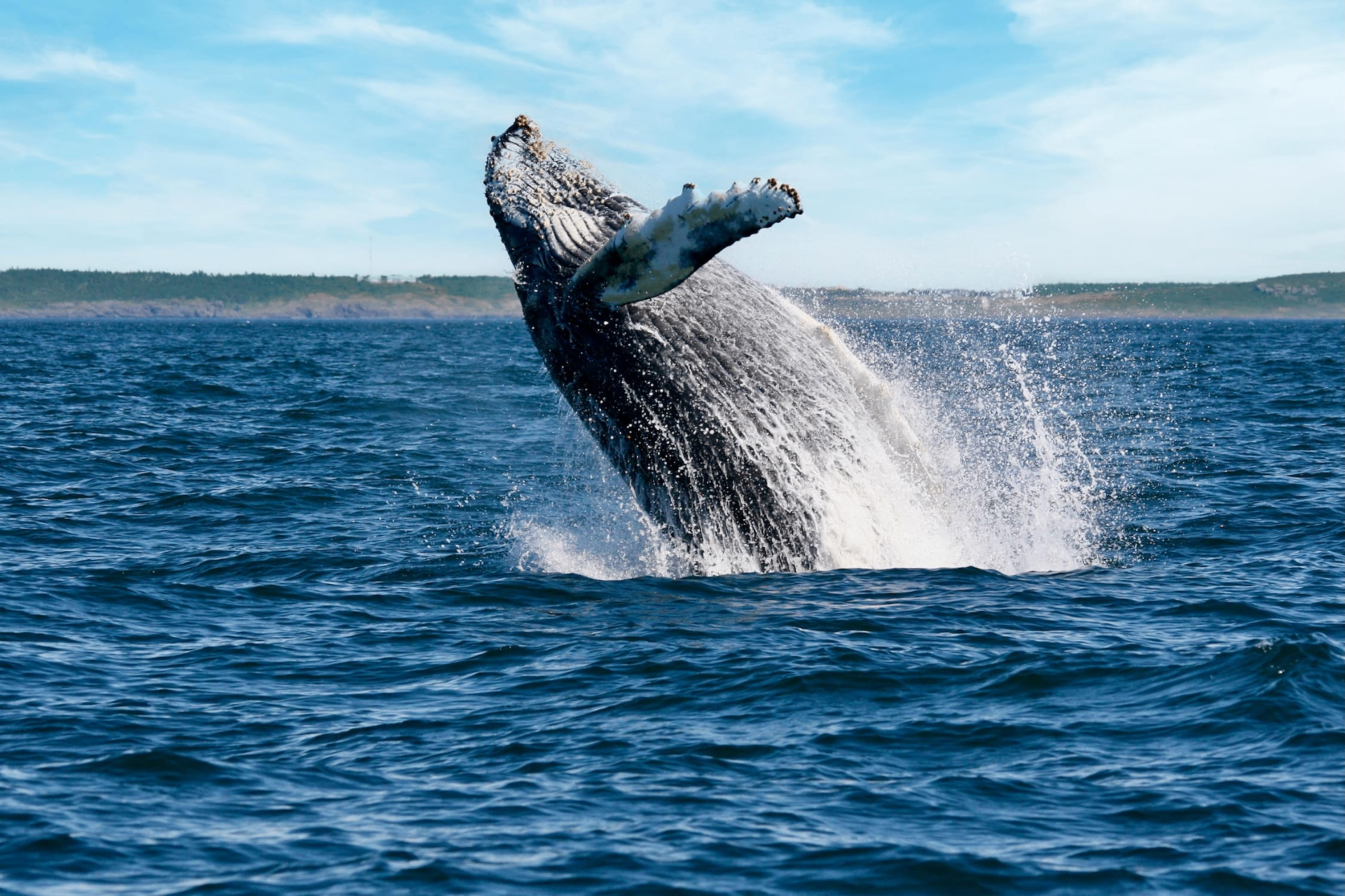
Humpbacks are the show-offs: knobbly heads, enormous white flippers, a humped back before the dive, and a broad tail fluke lifted clear of the water. That fluke is a fingerprint — researchers can identify individual humpbacks by the distinctive black-and-white pattern underneath.

Fin whales are long, sleek, and fast — often nicknamed the “greyhound of the sea.” They rarely lift their tail on a dive, and they have one of the strangest markings in the animal kingdom: the lower right jaw is white while the left is dark. Scientists think this unusual asymmetry may help with feeding, perhaps by startling or herding prey, although its exact function remains uncertain.

Minkes are the smallest of the three, reaching about nine to ten metres. They surface quickly with a pointed snout and a strongly curved dorsal fin, then disappear almost as quickly. Many first-time visitors see a minke without realizing they've just spotted a whale.
02

Why Fundy feeds them

Whales are here to eat, and Fundy's tides help create a remarkably productive feeding ground. Powerful currents, tidal fronts, mixing, and upwelling concentrate plankton and small schooling fish in productive areas around the outer bay. Humpback whales are particularly associated with these prey-rich waters around places such as Grand Manan and the Digby Neck–Brier Island area.

Humpbacks sometimes feed cooperatively using bubble nets: whales release streams of bubbles that help concentrate a school of fish, then lunge upward through the centre with their enormous mouths open. Their expandable throats allow them to engulf huge volumes of water and prey in a single feeding strike.

03

The rarest visitor

Fundy is also important habitat for the North Atlantic right whale, one of the world's most endangered large whales — fewer than 400 remain. The Bay was historically one of the species' major summer feeding areas.

In 2003, the shipping lanes leading into the Bay of Fundy were shifted to reduce overlap with feeding right whales. The 112-kilometre lane adjustment was an important early example of changing vessel traffic patterns specifically to reduce the risk of whale strikes.

Fun facts

01

Did you know

A humpback song can carry for hundreds of kilometres underwater, and every male in a population sings roughly the same tune — which slowly changes each year.

02

Did you know

Fin whales make calls at around 20 Hz, so low that they sit at the edge of human hearing.

03

Did you know

Whale exhalations — the blow — are visible from over a kilometre away on a calm morning and can reach three metres high.