Station 05.3 · Marine Mammals

The small, fast ones that show up when you've stopped looking.

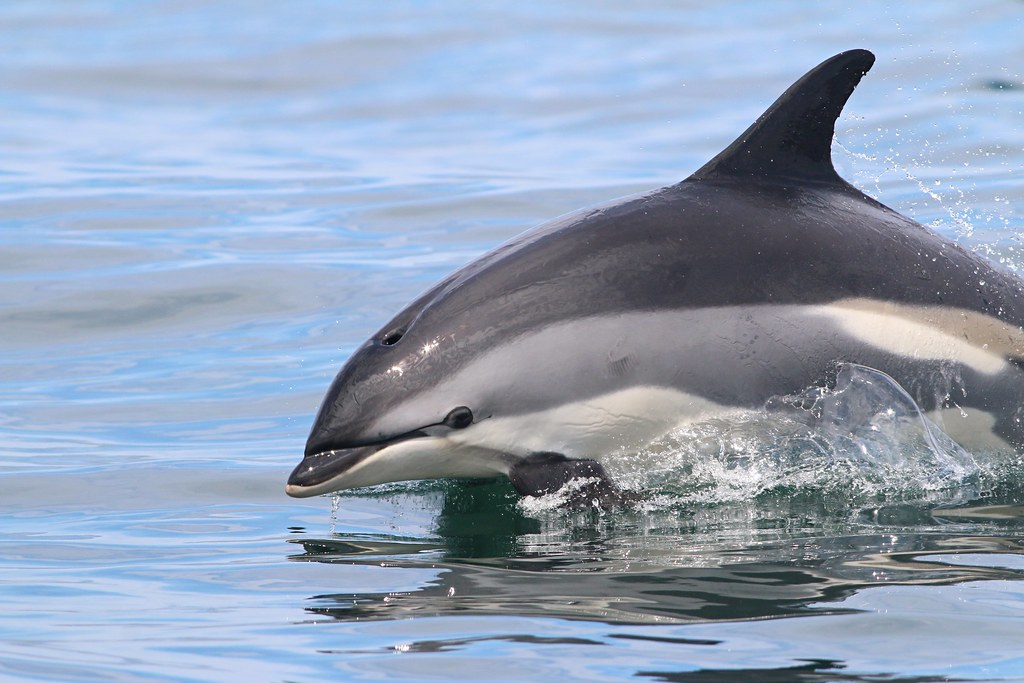
Fundy's smallest cetaceans are also its most energetic. White-sided dolphins travel in bright, noisy groups and love a boat's bow wave; harbour porpoises are shy, quiet, and so unassuming that many people mistake them for waves.

Atlantic White-sided Dolphin & Harbour Porpoise · Field record

Best season

Jun–Oct

Dolphin length

2.4–2.8 m

Yellow-and-white flank stripe

Porpoise length

1.4–1.8 m

Among the smallest cetaceans

Group size

2–60+

Dolphins travel largest

01

Dolphin or porpoise?

Dolphins have a beak-like snout, a tall curved dorsal fin, and cone-shaped teeth. Porpoises have a blunt face, a small triangular dorsal fin, and flattened, spade-shaped teeth. They belong to separate families — they are not simply two names for the same animal.

Behaviour can help too. Atlantic white-sided dolphins are energetic and social, sometimes leaping, bow-riding, and splashing at the surface. Harbour porpoises are much more understated: they often roll quietly at the surface, show only a small triangle of fin, and disappear almost immediately.
02

Living on a tidal conveyor belt

Both species hunt small schooling fish and squid and use echolocation — rapid clicks that bounce off objects and return information about their surroundings and prey. Harbour porpoises produce extremely high-frequency clicks, reaching around 130 kHz, well above the range of human hearing.

Fundy's strong tidal currents and tidal fronts create productive feeding areas where prey can concentrate. Harbour porpoises are often associated with these productive coastal waters, including areas around Grand Manan, Head Harbour Passage, and the Digby Neck.

Fun facts

01

Did you know

Harbour porpoises have a very high metabolism and need to feed frequently to support their small, fast-moving bodies.

02

Did you know

Atlantic white-sided dolphins get their name from the striking pale and yellowish patterns along their flanks.

03

Did you know

Porpoises and dolphins are both toothed whales, but their teeth, faces, fins, and swimming styles make them surprisingly easy to distinguish once you know what to look for.