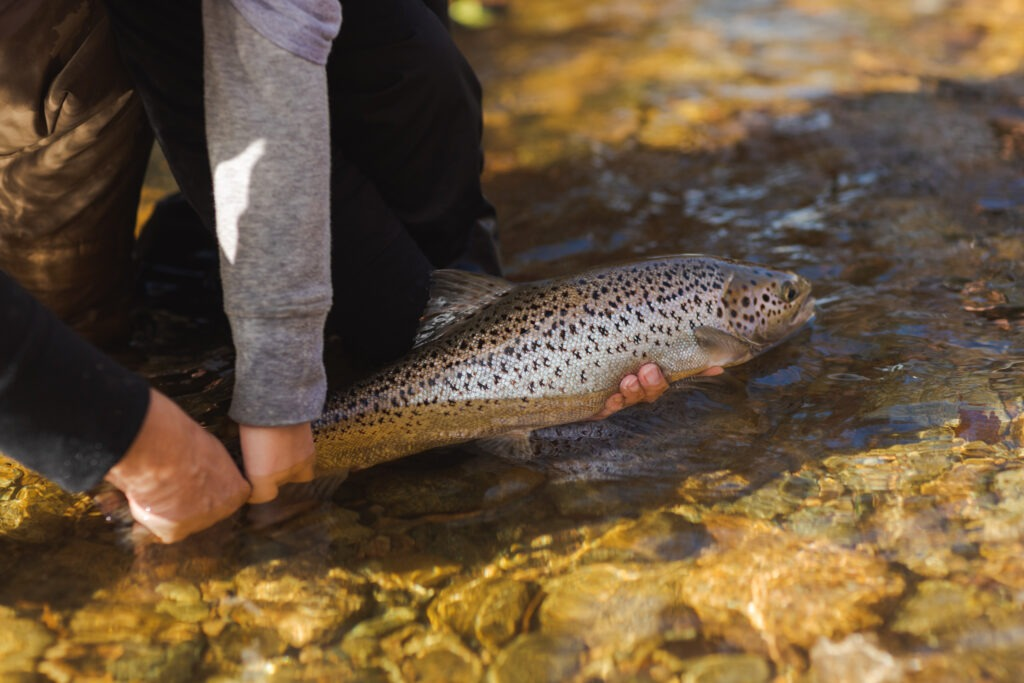
Station 05.4 · Fish & Shellfish

A fish that navigates an ocean to find the stream it hatched in.

Inner Bay of Fundy Atlantic salmon are among Canada's most endangered fish. They hatch in rivers like the Big Salmon and the Petitcodiac, feed in the bay, and return to spawn in the exact gravel bed where their own life began.

Atlantic Salmon · Field record

Status

Endangered

Inner Bay of Fundy population

Adult length

50–90 cm

A powerful fish built for fast water

Return season

Oct–Nov

Peak spawning period

Rivers

32

Rivers historically used by the population

01

A life in two waters

Atlantic salmon begin as eggs buried in gravel nests on the riverbed. They hatch as alevin, still carrying a yolk sac, then grow through the fry and parr stages in fresh water. After roughly two to four years, they become smolt — their bodies adapting to life in salt water — and begin their journey downstream to the sea.

Many Atlantic salmon populations make long ocean migrations before returning to their home rivers. The Inner Bay of Fundy population is different. Most of these salmon remain within the Bay of Fundy and Gulf of Maine, spending only about a year at sea before returning. This unusual migration pattern is associated with the population's distinctive genetic characteristics.
02

Finding the way home

Atlantic salmon can use several environmental clues to navigate their migrations. Scientists have found evidence that they can use Earth's magnetic field during ocean travel, while smell becomes especially important when they approach their home watershed.

Once they reach the right river system, chemical cues in the water help guide them toward their natal stream.

And unlike Pacific salmon, Atlantic salmon do not necessarily die after spawning. Some survive as kelts, return to the ocean, and can come back to spawn again.

03

Bringing them back

The Petitcodiac River causeway, built in 1968, severely obstructed fish passage and tidal flow and was one of several human impacts affecting the Inner Bay of Fundy ecosystem. The causeway gates were opened in 2010 as part of a long-term effort to restore tidal flow and fish passage.

Recovery work continues today. The endangered salmon population is supported by a Live Gene Bank, which maintains the unique genetic diversity of Inner Bay of Fundy salmon. Wild-origin juveniles are raised to adulthood, carefully bred, and their offspring released back into rivers as part of ongoing recovery efforts.

Fun facts

01

Did you know

Salmon can leap through fast-moving water and over natural obstacles as they make their way upstream to spawning grounds.

02

Did you know

Inner Bay of Fundy salmon are unusual among Atlantic salmon because most spend their marine phase close to home, in the Bay of Fundy and Gulf of Maine.

03

Did you know

Young salmon called parr have dark markings along their sides. When they become smolt and prepare for the ocean, they transform into a bright, silvery fish.